AI is reshaping how modern organisations operate, and the ones who lead this shift are known as Frontier Firms.
A Frontier Firm is a new kind of organisation. One where humans oversee trusted teams of AI agents that securely and responsibly operate around the clock, orchestrating complex processes and executing everyday tasks instantly, accurately and independently.
Meanwhile, human employees can focus on meaningful, high-value work that drives career progression and a culture of unmatched innovation.
These organisations don’t simply deploy AI tools; they build the secure foundations, cultural readiness, and technical excellence required to harness AI responsibly and at scale.
At ANS, we chose to go first.
Before advising customers on AI transformation, we became our own Customer Zero, deploying Microsoft 365 Copilot, GitHub Copilot, Copilot for Sales, Copilot for Service, and Copilot for Finance across the business.
This internal transformation helped us address industrywide challenges – growing workloads, burnout risks, and a need to scale impact without scaling headcount – while strengthening our governance, data foundations, and people development strategy.
Achieving this required multiple parallel workstreams, which now form the blueprint we use to guide customers through their own journeys:
- Technical Readiness – optimising deployment, governance, and security to create a trusted foundation.
- Human Change – preparing teams through onboarding, enablement, and real‑world scenario training.
- Continuous Iteration – gathering feedback, improving adoption, and evolving our approach as new capabilities (including agentic AI) emerge.
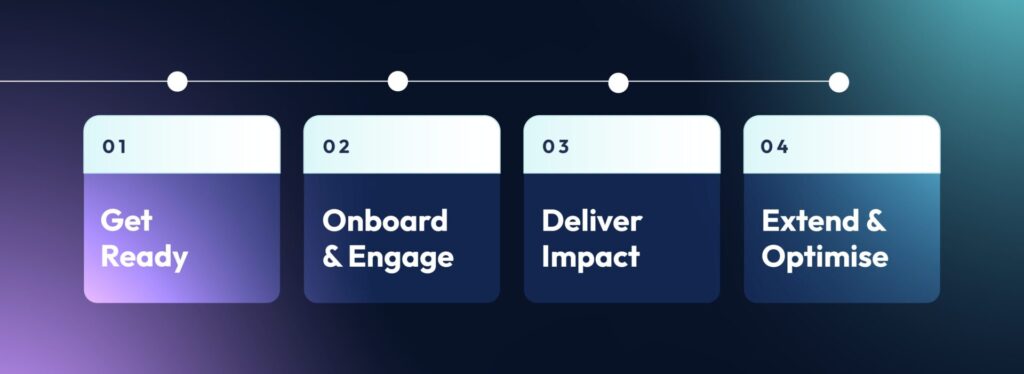
And, to structure our transformation, we followed the same progression we now deliver to clients – moving from AI readiness toward AI realisation through a clear, phased model:
- Phase 1: Get Ready – Create the conditions for AI to be adopted safely, securely, and successfully.
- Phase 2: Onboard & Engage – Supporting employees with training, communities, secure-by-design controls, and the right environment to adopt AI.
- Phase 3: Deliver Impact – Understanding where value was being unlocked, and how we could amplify success.
- Phase 4: Extend & Optimise – Scaling innovation and moving towards agentic AI.
By living this journey ourselves, we gained firsthand insight into what it really takes to become a Frontier Firm. The outcome wasn’t just technical uplift – it was organisational confidence, cultural momentum, and a business wide shift toward AI experimentation and innovation.
And now we’re sharing it all with you: the approach we took, the lessons we learned, and the framework we now use to help organisations think bigger, get AI ready, and become Frontier First.
“Becoming a Frontier Firm ourselves first gives us the credibility to guide our customers on their own journeys while empowering our people with cutting-edge AI tools to drive innovation.”

“Our people could see we were not only willing to go first, but willing to do it in a safe and controlled way to enable us to go faster. Clear, consistent comms helped everyone understand the journey, while embedding AI into our people development offering, and building in new AI skills within our career maps and development plans, ensured colleagues could see how these changes support their growth. It’s not just a tech shift; it’s a people one.”

Our transformation journey in 4 key phases.
Becoming a Frontier Firm doesn’t happen through a single project or deployment. It’s a strategic, organisation‑wide shift that unfolds through deliberate stages, each building the foundations for the next.
At ANS, our journey followed the same four-phase framework we now use with customers, rooted in Microsoft’s Copilot implementation model and expanded through our own experience.
Phase 1: Get Ready
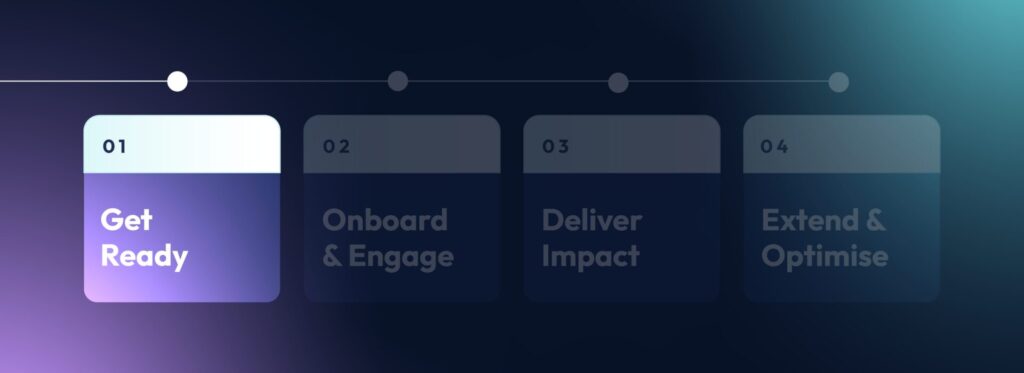
The first phase focused on creating the conditions for AI to be adopted safely, securely, and successfully.
That meant aligning leadership, establishing governance, and ensuring we had both the risk controls and the technical baselines to move forward with confidence.
What we did:
- Secured executive sponsorship and established an ANS AI Council, bringing together leaders across technology, data, security, people, and operations.
- Defined Responsible AI (RAI) principles, success criteria, and outcome measures.
- Launched risk identification and tracking, ensuring we understood compliance, information security, and data exposure considerations.
- Completed technical readiness work, including optimisation assessments, governance modelling, identity management, and enhanced security posture.
- Created clear scenarios and personas to define where early value could be found.
This early stage wasn’t just checklists and configuration – it was strategic alignment. And as this phase progressed, leadership alignment and support proved essential.
“A secure, governed approach wasn’t negotiable. Before we unleashed AI across the business, we made sure our foundations were airtight — from data controls to compliance guardrails.”

“Executive sponsorship wasn’t just a box to tick. The AI Council allowed us to make decisions quickly, challenge each other, and ensure AI was treated as a strategic priority — not an experiment.”
Phase 2: Onboard & Engage
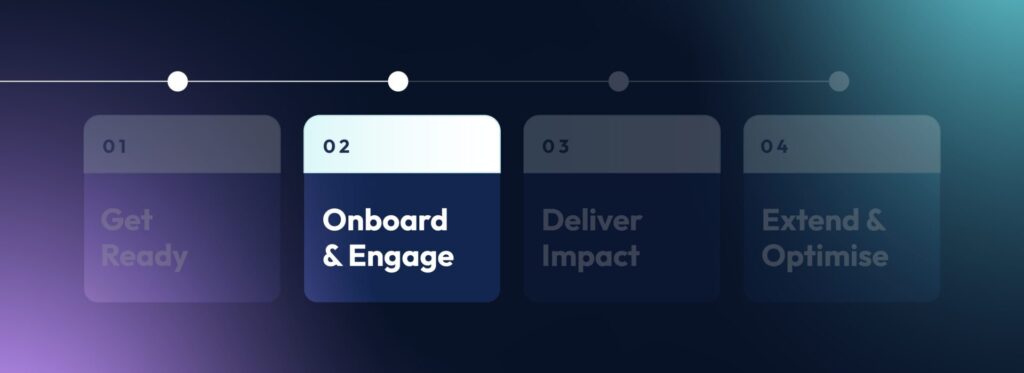
To move into true Frontier Firm territory, organisations need a parallel focus on human change and user adoption – helping employees understand what AI means for them, how to use it responsibly, and how it can unlock time, value, and creativity in their day‑to‑day roles.
What we did:
- Launched a company-wide enablement strategy, shaped around real scenarios and role‑specific examples.
- Delivered structured training for executives, early adopters, and wider teams.
- Built engagement communities, including a Centre of Excellence and internal Champion Platform.
- Hardened identity security, including Entra ID cleanup and role-based access refinements.
- Enhanced endpoint security using Microsoft Intune and Defender.
- Improved data security through SharePoint permission tightening, Purview policy updates, and new DLP rules.
From hands‑on Copilot workshops, to informal “Copilot Chats” where teams share wins, worries, and real-use examples, we’ve built a culture of continuous learning. These sessions have become a safe space for experimenting, asking questions, and helping teams translate AI into practical impact in their day-to-day roles.
We also post regular “Copilot Chats” videos on our YouTube channel, where ANS experts share their insights and experiences with Copilot for the benefit of both our staff and customers alike.
At our internal technical events, we host Copilot learning sessions and “promptathons” to encourage user adoption and experimentation as staff members learn to adopt AI into their own workflows.
This phase-built confidence, capability, and – crucially – momentum.
“As an Enablement Lead, I saw first‑hand how critical it was to align technical readiness with user enablement. We built communities, iterated on feedback, and made sure our people felt supported every step of the way. When we set up the Champion Platform, the real turning point was when people started sharing their own wins. It stopped being ‘training’ and became a community — people teaching people.”

Phase 3: Deliver Impact
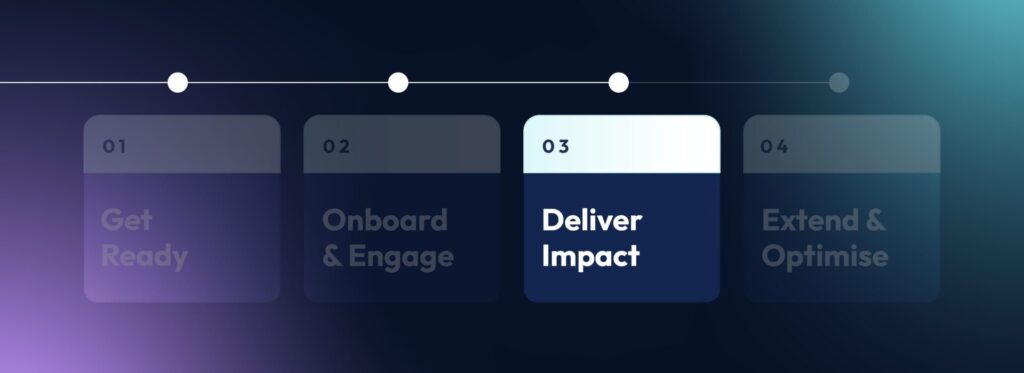
With strong foundations and engaged teams, the next phase shifted our focus to understanding real impact: what was working, where value was being unlocked, and how we could amplify success.
What we did:
- Reviewed success measures, adoption metrics, and usage insights from a range of dashboards and analytics.
- Gathered user stories from across the business to highlight tangible impact.
- Iterated our user experience strategy, updating enablement materials based on feedback.
- Refined scenarios to focus on high‑value, role-specific use cases.
- Presented at board meetings and company updates for transparency and visibility.
This phase allowed us to transform early wins into repeatable, organisation‑wide practices – a key requirement for Frontier Firm maturity.
Phase 4: Extend & Optimise
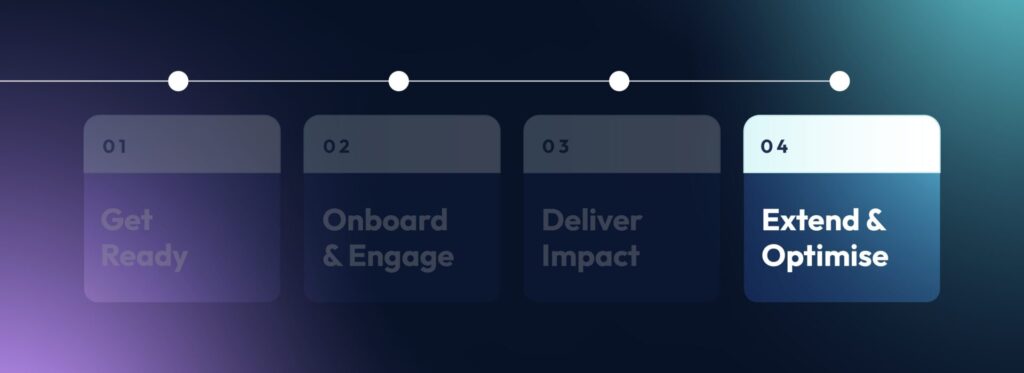
Once the foundations were stable and value was emerging, we expanded into deeper, more transformative capabilities – the kind that move an organisation into true Frontier Firm territory.
What we did:
- Introduced new high‑value AI scenarios based on business needs and the intent to completely transform business processes.
- Continued optimisation, with ongoing security, governance, and experience tuning.
- Planned for agentic AI, laying the groundwork for autonomous workflows and outcome‑oriented digital labour.
This stage is where AI became woven into our operating model – moving beyond a tool for productivity and into a capability that continuously evolves. Being at this stage ensures that ANS can benefit from AI across these key outcomes (and by extension so can our customers):
- Revolutionise the way our business works
- Productivity, without the burn out
- Growth, without the overheads
- AI Adoption, without the risk
- Removal of the risk of Shadow AI
Key outcomes of becoming a Frontier Firm
Our transformation wasn’t just a technical exercise; it delivered measurable impact across the business.
By following a structured, secure, people‑first approach, we achieved outcomes that strengthened both our operational excellence and our organisational culture.
Quantitative outcomes
These are the measurable improvements that show our readiness, maturity, and ability to scale AI safely:
- Reduced organisational risk, driven by strengthened identity controls, tightened SharePoint permissions, and improved data governance – resulting in a 52% decrease in data labelling alerts.
- Higher compliance scores through enhanced configurations across Entra, Defender, Intune, and Purview – including a 36% decrease in communication compliance alerts.
- Strong adoption rates, with consistent increases in Copilot usage, scenario engagement, and successful early‑adopter participation.
- Improved security posture, reflected in fewer policy violations, clearer access boundaries, and more predictable data flows – resulting in a 66% reduction in data loss prevention alerts.
- Improved productivity, as teams adopted AI to streamline routine work, accelerate role impact, and make faster, more informed decisions. The Sales function, for example, has seen a 6.25% closing ratio uplift as a result.
These metrics show the operational uplift that underpins Frontier Firm capability – safe, trusted, governed, and scalable.
Qualitative outcomes
Just as important were the human and cultural shifts that emerged throughout the journey:
- A cultural move toward experimentation and innovation, reflected in growing communities, champions, and cross‑team collaboration.
- Greater trust and confidence in AI, thanks to transparent governance, clear communication, and consistent enablement – leading to continued investment across the business in the millions.
- Stronger organisational alignment, with leaders and teams united behind a shared strategy for how AI should be used, governed, and expanded – with an organisational ambition for one agent per ANS employee by the end of 2026.
Together, these outcomes show that the transformation wasn’t just about deploying AI – it was about reshaping how ANS works, learns, collaborates, and delivers value.
3 lessons we learned – that you can follow
Our transformation taught us that becoming a Frontier Firm isn’t about chasing the newest AI tools – it’s about building the right foundations, aligning your people, and committing to long‑term, responsible innovation.
For organisations looking to begin or accelerate their own journey, a few lessons stand out:
1. Start with leadership alignment and a clear readiness checklist
AI transformation succeeds when leaders move together with a shared vision and a shared understanding of risk, governance, and value.
Checklist:
- Align your executive team around why AI matters for your organisation.
- Establish governance early — including RAI principles, data boundaries, and security expectations.
- Use a structured readiness checklist to assess your cloud, data, security, identity, and change‑management baselines.
Without this level of alignment, organisations risk fragmented adoption, uneven experiences, and unnecessary exposure. With it, AI becomes a strategic enabler rather than a tactical experiment.
2. Balance technical readiness with human change from day one.
Technology will get you started – but people will carry you through. Organisations that over‑index on technology struggle with adoption. Those that invest equally in education, community building, champions, and feedback loops create momentum, trust, and long‑lasting cultural change.
Checklist:
- Invest in education and enablement: Provide training and resources for all staff, building a culture where teams can confidently learn, experiment, and adopt AI in their roles.
- Build feedback loops and communities: Establish champions and communities of practice to encourage sharing, support, and continuous improvement as AI adoption grows.
- Monitor adoption and adjust: Track both technical and human progress, using feedback to iterate on your approach and ensure sustainable, organisation-wide change.
Bear in mind that this is by no means an exhaustive list. But it’s a good place to start to avoid the pitfalls of focusing solely on technology or people.
The most successful AI transformations are those where technical guardrails and human empowerment go hand in hand, building momentum, trust, and lasting cultural change.
3. Take advantage of the ecosystem of resources.
No organisation needs to tackle this journey alone. Thankfully, there are plenty of resources out there from a variety of partner organisations to help you along.
Microsoft for example, provides a rich set of support tools and programmes designed to accelerate safe, impactful AI adoption.
Checklist:
- Microsoft Learn — world‑class training materials, certifications, and learning paths to upskill your teams.
- Microsoft Adoption resources — templates, playbooks, communication kits, and training assets to help drive cultural change at scale.
Leveraging resources like these – as well as those provided by channel partners – reduces the burden on internal teams and shortens the path from AI readiness to AI realisation. There is, however, no substitute for actual experience and real-world realities to validate your approach.
So, did we follow our own advice?
One of the most valuable parts of our transformation was the ability to look back and assess our journey with honesty. And the truth is: yes, we followed most of our own guidance — but not always perfectly, and not always in the order we expected.
In reality, transformation is rarely a straight line.
“We had strong leadership alignment from the start, but once we saw the true scale of the transformation ahead, we weren’t afraid to rethink and reshape our approach. The AI Council didn’t stay static — it evolved as we learned more and moved faster. That willingness to adapt, challenge ourselves, and stay flexible wasn’t just helpful — it was essential to driving real momentum.”
There were places where we adapted, accelerated, or iterated based on what we learned along the way. Some steps took longer than expected (like hardening identity), while others moved faster once teams saw early value. That’s the reality for any organisation stepping into AI transformation: the framework gives structure, but learning in motion gives momentum.
And that’s exactly why we now share these lessons — so other organisations can start with clarity, avoid our early missteps, and accelerate their own path to becoming a Frontier Firm.
“One of the biggest risks was the potential for unintentional data exposure. Enabling Copilot to surface organisational knowledge from SharePoint meant we had to apply rigorous information governance, tightly scoped access boundaries, and a consistent, enterprise-wide approach to security and data classification. To prepare for AI at scale, we established clear architectural principles that prioritised data quality, secure access boundaries, and responsible use. These principles ensured that every AI capability we introduced was grounded in governance, resilience, and repeatable design.”

Ready to accelerate your own Frontier Firm journey?
Our transformation proves that becoming a Frontier Firm isn’t theoretical – it’s practical, achievable, and already happening inside organisations that commit to the right foundations. If you’re ready to turn AI ambition into real‑world impact, you don’t have to take the journey alone.
Our AI Readiness Assessment is a structured engagement that maps your current landscape and provides a roadmap for successful Copilot and Agentic AI implementation.
It will help you understand how to lay technology foundations across Cloud, Security and Data, as well as putting Enablement plans in place to ensure widespread adoption.
Sign up for an AI Readiness Assessment today and chart your course to the Frontier.