





Data Insights Services.
Modern businesses thrive on insights. Our data warehousing and analytics solutions consolidate your data into a single, governed platform, enabling real-time reporting, advanced analytics, and AI-driven decision-making. Whether you’re starting your data journey or scaling for innovation, ANS helps you turn raw data into actionable intelligence.
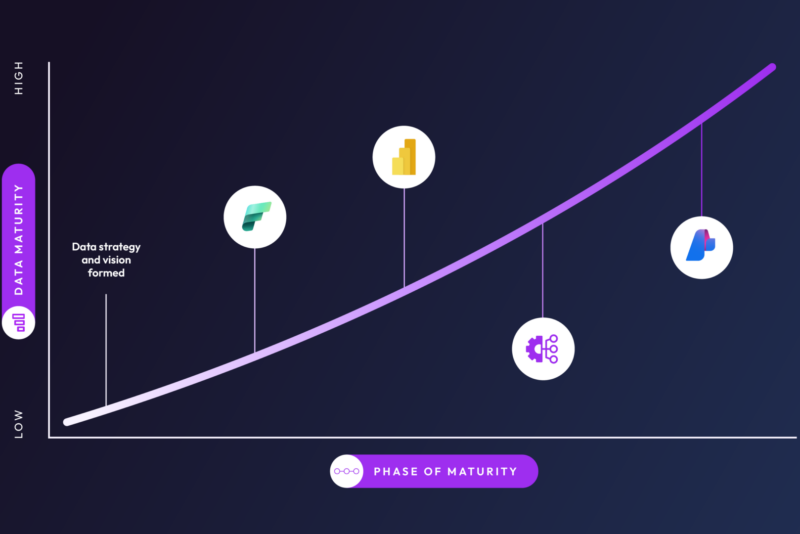
The Data Maturity Journey
Benefits of Utilising Data Warehousing & Analytics
Enhanced Decision Making
Leverage accurate data insights to make informed strategic decisions and stay ahead of the competition.

Increased Efficiency
Streamline your operations with our efficient data warehousing solutions.

Cost Savings
Optimise your data management costs with our scalable and cost-effective solutions.

Improved Security
Protect your sensitive business data with our top-tier security protocols.


Data Warehousing
A data warehouse is a centralised, secure repository that brings together data from all your business systems —CRM, ERP, finance, and more— into one governed platform.
Instead of chasing data across multiple sources, you get a single source of truth for accurate reporting and compliance. This means faster decision-making, reduced operational overhead, and a foundation ready for advanced analytics and AI.

Analytics
Analytics transforms raw data into actionable insights through dashboards, reports, and predictive models.
It helps you spot trends, forecast outcomes, and make proactive decisions—whether that’s improving customer engagement, optimizing supply chains, or reducing costs. With advanced analytics, you move beyond “what happened” to “what will happen” and “what should we do next.”
Solving Your Business Problems
Customer Relationship Management (CRM)
By integrating CRM data with other business systems, companies can gain deeper insights into customer behavior, preferences, and trends, leading to personalized marketing strategies and improved customer satisfaction.
Supply Chain Management
Integrating data from suppliers, manufacturers, and distributors helps streamline supply chain operations, optimize inventory levels, and reduce costs.
Financial Reporting
Data integration ensures accurate and timely financial reporting by consolidating data from various financial systems, facilitating better financial planning and analysis.
Sales & Marketing Analytics
Analyse pipeline performance and campaign ROI to make data-driven decisions that boost revenue.

ANS Co-Managed Data Service
ANS’ Co‑managed Data Service gives you always‑on expertise to run, monitor and optimise your entire data platform. We combine proactive monitoring, platform optimisation and access to specialist data engineers and architects to keep your pipelines, models and analytics running smoothly and securely. With ANS taking care of the heavy lifting, your teams stay focused on driving insight, value and competitive advantage from your data.
Why Partner with ANS?
As a Microsoft-accredited partner and the 2025 UK Partner of the Year, ANS brings years of proven expertise in delivering end-to-end data solutions across the full Microsoft ecosystem – empowering organisations to build strong data foundations and accelerate their journey to being AI ready.

500+ Modern Data Platforms Delivered
Proven experience delivering scalable, secure data platforms for organisations across multiple sectors.
Our UK Based co-managed data platform service team work alongside yours to manage and optimize your platform without losing control.

Microsoft UK Partner of the Year
On demand data expertise that is industry recognised.

Fabric Featured Partner
Early adopter and trusted advisor for Microsoft Fabric, helping customers unlock unified analytics.

Expertise across the full Microsoft Ecosystem
End‑to‑end solutions spanning Azure, Power Platform, Dynamics 365, and Copilot for seamless integration and to unlock the power of your data across your business.



FAQs
How is a data warehouse different from a normal database?
A normal operational database (for example, the one behind a single application like sales or inventory) is primarily designed to record ongoing transactions and support day-to-day operations. In contrast, a data warehouse integrates data from across the entire business and is optimized for analysis and reporting rather than transactions. Key differences include:
- Scope: Databases usually handle a specific domain or department, whereas a data warehouse stores combined information from many departments (sales, marketing, finance, etc.).
- Data history: Operational databases often keep only current data needed for immediate processes. A data warehouse maintains current and historical data, allowing analysis over time (e.g. year-over-year trends).
- Purpose: Data warehouses are structured to enable complex queries, business intelligence reporting, and discovering insights (they can quickly answer questions like “What were our regional sales trends over the last 5 years?”). A regular database isn’t as efficient for this kind of cross-cutting analysis.
- Single Source of Truth: Because a data warehouse aggregates all data into one repository, it provides a single, consistent source of information for decision-making, whereas individual databases only offer a partial view.
By using a data warehouse, businesses ensure everyone is analyzing the same comprehensive data rather than pulling from separate systems.
How can data warehousing and analytics benefit my business?
Data warehousing and analytics deliver several key business benefits:
- Better Decision-Making: With a data warehouse, decision-makers have access to all relevant data in one place, rather than piecemeal information. This means decisions can be based on complete, up-to-date facts. Reports and dashboards powered by a data warehouse help leaders spot trends and patterns that inform strategic choices. In fact, a well-designed data warehouse underpins successful BI (Business Intelligence) programs by providing the data needed for data-driven decisions on everything from daily operations to long-term strategy.
- Increased Efficiency & Speed: Analysts and business users spend far less time gathering data manually. Because data is already consolidated and structured for analysis, answering questions becomes much faster. Queries that might take hours by combing through separate spreadsheets can be answered in seconds via a data warehouse. This efficiency frees up staff to focus on analysis and action rather than data wrangling.
- Historical Insights: Data warehousing allows you to look at historical data easily – you can identify trends over years and do year-over-year comparisons, which would be difficult if data were scattered in different systems. Learning from past patterns (seasonal sales fluctuations, customer behavior changes, etc.) helps in forecasting and planning.
- Improved Data Quality and Consistency: In a data warehouse, data from various sources is cleaned and standardised during the loading process. This leads to more consistent and accurate data across the organisation. Users trust that the figures on their dashboards (e.g. revenue, customer count) are uniform and reconciled, which reduces confusion and disputes over “whose numbers are correct”.
- Cost Savings & ROI: While there is an investment in building a data warehouse, it often pays for itself by streamlining reporting and eliminating redundant data systems. Moreover, modern cloud data warehousing solutions use pay-as-you-go models, so you only pay for the resources you use, avoiding large capital expenditures. By optimising operations and uncovering efficiency improvements (for example, finding supply chain bottlenecks or redundant expenses through data analysis), businesses can save money in the long run.
Overall, data warehousing and analytics turn your data into a strategic asset – driving smarter decisions, faster insights, and better business performance.
Is my data secure in a data warehousing solution?
Yes – data security is a top priority in reputable data warehousing solutions. Providers implement robust safeguards to protect your sensitive information. For example, modern data warehouses typically include encryption (to protect data at rest and in transit), access controls (so only authorised users can view or query data), and regular security audits. In cloud-based data warehouses, major cloud providers handle much of the heavy security lifting, offering enterprise-grade protection and reliable backup/disaster recovery options by default. [
ANS and similar providers also prioritise data protection with strong security measures, giving you peace of mind that your business data is safe. They ensure compliance with data regulations (such as GDPR in the UK) and often offer data residency options (storing data in-region, e.g. within the UK, to meet compliance needs). In short, a well-architected data warehouse will keep your data confidential, intact, and available only to those who should have access.
Will a data warehouse work with my existing systems and data?
Absolutely. Modern data warehousing solutions are designed to integrate with a wide range of existing systems. Whether your data resides in legacy on-premises databases, cloud applications, Excel sheets, or even various departmental systems, it can be ingested (imported) into a data warehouse. These solutions can pull data from multiple sources and formats (structured tables, semi-structured files, etc.) and consolidate it for you.
In practice, this means you don’t have to overhaul all your current systems. A well-planned data warehouse will connect to or import from your CRM, ERP, sales databases, or any other data sources you have. For example, if your customer data is in one system and order data in another, a data warehouse can bring those together, so you can easily run a report on customer purchase behavior across all products. ANS’s approach, for instance, is to help bring together data stored across multiple systems or departments into one unified platform, creating a clear unified view of all your information.
The result: you continue using your existing operational systems as needed, while the data warehouse layer aggregates their data for comprehensive analysis. This integration capability is a core strength of data warehousing.
Do we need technical expertise or a large IT team to implement and use data warehousing and analytics?
Not necessarily. While implementing a data warehouse does involve technical work (data modeling, ETL processes, etc.), you don’t need to do it all alone – that’s where a vendor or service partner can help. Providers like ANS offer services to design, implement, and even fully manage the data warehousing solution for you. This means even if your in-house IT team is small, you can leverage external expertise to set up the platform.
Once the data warehouse and analytics tools are in place, using them day-to-day can be quite user-friendly. Most modern analytics platforms include intuitive dashboards and reporting tools. You can access your data through interactive dashboards, charts, and natural-language queries without needing to write complex code. For instance, ANS often delivers customisable dashboards that highlight the metrics that matter most to your business – so business users can simply log in and see key performance indicators, drill down into reports, or run queries via a point-and-click interface.
In summary, you do not need a large in-house IT staff to benefit from data warehousing and analytics. With a combination of the right partner support and user-friendly BI tools, these solutions are accessible to non-technical users. Your team can focus on making decisions from the insights, rather than worrying about the technical mechanics behind the scenes.
Is data warehousing only for large enterprises, or can small businesses use it too?
Data warehousing and analytics are not just for big corporations – organisations of all sizes can benefit. In the past, only large enterprises with big IT budgets could afford massive data warehouses. But today, thanks to cloud computing and scalable services, small and medium-sized businesses can also implement data warehouses cost-effectively.
Cloud data warehousing solutions (like Azure Synapse, Amazon Redshift, etc.) operate on a pay-as-you-go model, which means you can start small – you pay only for the storage and compute power you actually use. If your data needs grow, the warehouse can scale up accordingly, but you won’t be over-investing from the start. This elasticity makes data warehousing accessible even to a startup or local business that wants better insight into its data.
Moreover, pre-built analytics tools and templates can shorten the time to value, so a smaller company doesn’t need a huge project to get started. Many ANS clients, for example, begin with a modest data warehouse focusing on a few key data sources, then expand as they see the benefits. With cloud infrastructure, the playing field is leveled – you can leverage enterprise-grade data analytics capabilities without owning a data centre or spending a fortune upfront.
In essence, any business that collects data (large or small) stands to gain from organising and analyzing it. Even for a small business, insights like understanding customer behavior, sales trends, or operational inefficiencies can drive growth. Data warehousing and analytics, done at the appropriate scale, can provide that insight in a manageable, affordable way.
Is implementing a data warehouse expensive?
Implementing a data warehouse doesn’t have to be prohibitively expensive. The cost will depend on factors like the volume of data, the complexity of your needs, and the solution you choose (cloud vs on-premises). However, modern cloud-based data warehouses have significantly lowered the cost barrier. With cloud services, you avoid massive upfront investments in hardware and software – instead, you typically pay month-to-month based on usage. This consumption-based pricing means you can start with a smaller budget and scale up as needed, which is very cost-efficient.
Additionally, maintenance and support costs tend to be lower with cloud solutions (since the cloud provider handles much of the maintenance). You also save costs by reducing manual effort: once in place, a data warehouse automates data consolidation that might otherwise be done through labor-intensive means.
Importantly, a data warehouse can provide a strong return on investment (ROI). By unlocking insights, it can highlight opportunities to increase revenue or cut costs. For example, analytics might reveal a segment of customers with unmet needs (a revenue opportunity) or identify inefficient processes that are wasting resources (a cost-saving opportunity). These improvements can offset the costs of the system over time. In fact, ANS’s own solutions emphasize cost-effectiveness and often help optimise data management costs for clients.
In summary, while there is a cost to implement a data warehouse, it is very much a scalable investment. Businesses can choose a solution size that fits their budget, and the benefits gained (better decisions, efficiencies, competitive advantage) usually outweigh the expenses in the long run.