




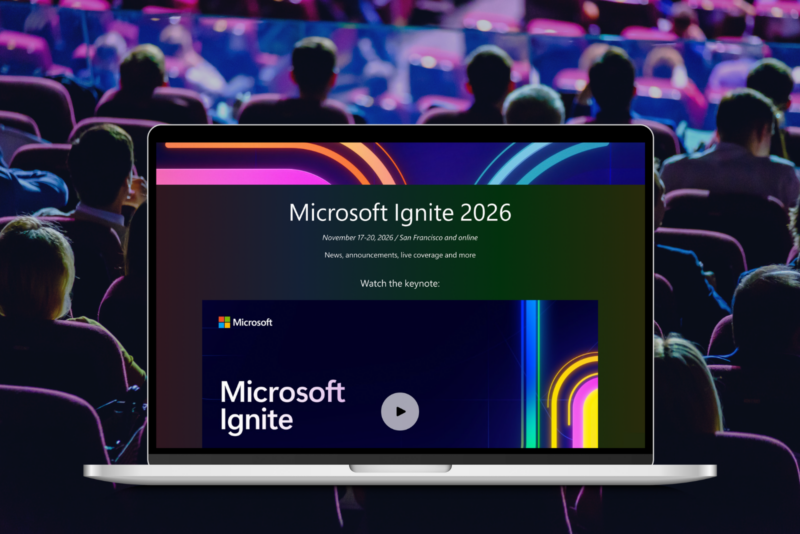
For the past few years, the AI conversation has largely focused on capability: what the technology can generate, automate or help an individual employee do faster.
Microsoft Ignite 2026 points towards a different challenge.
Microsoft is bringing AI deeper into the systems, data and processes that organisations depend on every day.
Copilot is becoming what Microsoft calls the “new operating system for work”. Agents are becoming persistent. Dynamics 365 is bringing AI closer to core business processes. Microsoft IQ is giving those systems richer organisational context.
Meanwhile, new security, identity and management capabilities are emerging to govern an increasingly autonomous AI estate.
The direction is significant for any organisation looking beyond AI experimentation towards measurable business value.
Here are eight developments from Ignite that we believe deserve particular attention, and what they could mean in practice.
1. Microsoft IQ: your data needs to become usable context
One of the most important announcements was Microsoft IQ, Microsoft’s new enterprise context management platform.
Microsoft IQ helps organisations capture, govern and reuse their own knowledge as context for AI applications and agents. It brings together capabilities including Work IQ, Fabric IQ, Foundry IQ and Web IQ.
Microsoft’s premise is straightforward: agents are only as useful as the context they have about the organisation in which they’re working.
That’s an important distinction.
Most organisations don’t lack data. They have vast quantities of it, distributed across documents, emails, applications, databases and collaboration platforms.
Microsoft says more than 19.5 exabytes of data already sits within Microsoft 365 alone, with billions of emails, Teams messages and files added every week.
The challenge is turning that information into accurate, accessible and appropriately governed context.
For businesses, AI readiness increasingly depends on context readiness.
Poor-quality, fragmented or inaccessible information limits what an agent can understand.
Weak permissions introduce risk. Well-governed data gives AI something much more valuable: a reliable understanding of customers, processes, relationships and organisational knowledge.
As powerful AI models become widely available, proprietary organisational context could become one of the areas where businesses create genuine differentiation.
The question therefore becomes: if an AI agent needed to understand how your organisation works tomorrow, would your data estate give it reliable answers?
2. Microsoft Perception: cybersecurity starts moving at machine speed
AI is changing the threat landscape as well as the workplace.
Microsoft used Ignite to announce the general availability of Microsoft Perception, bringing together specialist AI agents across security operations.
Microsoft describes red-team agents that simulate attacks, blue-team agents that detect them and green-team agents that support remediation.
The significance is speed.
Automated and increasingly agentic attacks put pressure on security teams that traditionally rely on humans investigating alerts, determining priorities and coordinating remediation.
Attackers operating at machine speed create a strong case for defenders to respond at comparable speed.
AI agents can increasingly help analyse vulnerabilities, correlate information and propose remediation while security professionals maintain control over important decisions.
The Intune Vulnerability Remediation Agent, announced in limited public preview, combines Defender vulnerability intelligence with Intune device and application context to help administrators prioritise risks and prepare remediation playbooks.
For security leaders, the opportunity here is distinctly human led, AI enabled: let machines handle the volume and repetition while people retain judgement, accountability and oversight.
3. Agent 365: AI FinOps becomes a business discipline
As agents start performing more work, another challenge quickly emerges: how do you know whether they’re worth the money?
Microsoft is positioning Agent 365 as an enterprise control plane covering agent identity, security, governance and operations.
At Ignite, it also announced Agent 365 Business Analytics in Frontier preview, designed to connect AI expenditure with usage and business outcomes. The information available depends on the user’s role, organisational settings and use of supported services.
Building on Microsoft’s earlier FinOps for AI announcements, this represents a further step towards a broader AI FinOps discipline.
AI costs don’t necessarily behave like traditional software licensing. An increasingly sophisticated estate could consume models, tokens, compute, APIs, data services and Copilot Credits at different rates.
Simply asking, “How much are we spending on AI?” isn’t enough.
Businesses need to understand which agents consume resources, which activities drive that consumption and what business outcome they ultimately produce.
The objective shifts from simply reducing costs towards optimising the unit economics of AI.
A more expensive agent that removes hundreds of hours of repetitive work could represent excellent value. A cheap agent nobody uses provides little return at all.
For organisations planning to scale AI considerably over the next few years, those economics need to become visible before complexity grows.
4. Copilot as the operating system for work: AI Realisation comes into focus
Perhaps the clearest indication of Microsoft’s direction came from its description of Copilot as the “new operating system for work”.
Microsoft announced Copilot Workspaces, where employees and agents can collaborate against shared goals and context. It also announced general availability for Copilot Home, which brings Chat and Cowork together, and Office in Copilot. Home and Office in Copilot had previously been introduced in September.
For organisations already deploying Copilot, this should prompt a change in conversation.
Early AI adoption understandably concentrated on questions such as: “How do we get employees using Copilot effectively?”
The more interesting question now is, “Which parts of our organisation could work differently because AI exists?”
That’s the shift from AI Readiness to AI Realisation.
The opportunity begins with identifying processes where AI can create measurable improvements: reducing manual work, accelerating decisions, removing hand-offs, increasing capacity, or improving customer experiences.
Copilot adoption gets AI into people’s hands. AI Realisation redesigns work around what people and AI can achieve together.
5. Dynamics 365: AI moves into the systems where work happens
Microsoft announced generally available updates to the Dynamics 365 Sales, Dynamics 365 Customer Service and Dynamics 365 ERP apps plugins for Copilot, with dozens of pre-built skills spanning customer-facing and finance and operations workflows.
Those capabilities stretch from pipeline prioritisation and meeting preparation to supplier management and account reconciliation.
This matters because important business processes rarely live entirely inside an email, meeting or document. They flow through CRM, ERP, finance, service, and other line-of-business systems.
Consider a sales process. An agent might eventually research an account, retrieve relevant organisational knowledge, examine CRM data, evaluate an opportunity, prepare an account brief, recommend an action, draft follow-up communications and prepare CRM updates for human approval.
Viewed individually, each task represents incremental productivity.
Connected together, they start to change the process itself.
That’s where Business Applications, Power Platform, Copilot and agents increasingly converge.
The systems of record that hold customer, financial and operational information can also become part of the environment through which AI acts.
The biggest gains from agentic AI are therefore likely to emerge when agents can safely participate in the processes that run the business.
6. Autopilot and Entra: digital workers need identities too
At Ignite, Microsoft’s Autopilot began rolling out to Frontier customers, following its introduction in September. Its ability to carry out persistent work makes the governance challenge more tangible.
Autopilot is designed to carry out persistent work without requiring a fresh prompt at every stage. Microsoft gives examples including monitoring Teams channels, following up emails and managing recurring projects.
Greater autonomy inevitably creates questions about authority.
Businesses have spent years developing identity controls around employees. Who are you? What can you access? What actions can you perform? Who approved that access? What happens when you leave?
Autonomous agents need equivalents.
Microsoft is addressing this through Entra Agent ID. Each Autopilot can have its own identity and named manager, while actions and sign-ins can be logged independently.
Microsoft is also developing agent-specific Conditional Access, risk assessment and MCP security controls.
This is innovation with guardrails becoming increasingly concrete.
Before businesses scale autonomous agents, every digital worker should have:
- clear ownership;
- an identifiable purpose;
- least-privilege access;
- defined approval thresholds;
- monitoring and auditability;
- lifecycle management.
The ability to automate a process doesn’t remove the requirement to control it.
7. Azure is becoming an agentic platform
The agentic shift extends beneath applications and productivity tools into Azure itself.
Microsoft announced Azure Catalyst, which brings together discovery, planning, migration, modernisation and code intelligence to support organisations modernising infrastructure, applications and databases.
Microsoft is also expanding agent-led cloud operations through Azure Copilot, Azure SRE Agent, Azure Monitor and the Azure Resource Manager MCP Server.
That has two implications.
First, legacy technology estates could increasingly constrain AI Realisation. Valuable organisational knowledge is often embedded within applications, databases and years of business logic. Modernisation can make those assets easier to incorporate into new AI-powered experiences and processes.
Second, AI can help modernise and operate that estate itself.
Microsoft’s vision of agentic operations involves agents continuously observing cloud environments, reasoning across signals and helping teams take action around performance, cost and reliability, while maintaining human oversight.
In other words, the cloud becomes both the foundation for AI and a beneficiary of AI.
For organisations carrying substantial technical debt, AI transformation and cloud modernisation are likely to become increasingly difficult to separate.
8. Microsoft’s expanding model portfolio makes model choice an AI FinOps question
One of Ignite’s less obvious developments could prove highly significant for the economics of enterprise AI.
Microsoft is expanding its own AI model portfolio across specialist tasks including coding, cybersecurity, images, audio and decision-making.
Microsoft-Decision-1.1, for example, is designed to handle tasks including routing, classification, prioritisation, validation and workflow control quickly and at relatively low cost.
That illustrates an important AI architecture principle:
The most powerful model isn’t necessarily the right model for every job.
An agentic business process might use one model to classify an incoming request, another to retrieve information, another for complex reasoning and another to validate an output.
Sending every task to the most capable frontier model could introduce unnecessary cost and latency.
Microsoft is already applying this principle within Copilot. Its Auto routing dynamically selects models and reasoning effort according to the task, balancing quality, speed and cost.
This creates a second dimension to AI FinOps.
Agent 365 Business Analytics is intended to help organisations assess AI usage, expenditure and business outcomes across supported services, subject to role and organisational settings. Intelligent model selection addresses a complementary question: how to optimise the unit economics of the tasks AI performs.
The ANS perspective: capability is accelerating faster than organisational readiness
Taken together, these announcements tell a bigger story.
Microsoft is assembling more of the technology required for organisations where people and agents work together:
- Copilot becomes the environment through which work happens.
- Dynamics 365 connects AI with operational business processes.
- Microsoft IQ provides organisational context.
- Autopilot introduces greater autonomy.
- Entra and Agent 365 provide identity, governance and control.
- Perception helps security operate at machine speed.
- Azure provides an increasingly intelligent underlying platform.
- Specialist models give businesses more choice over the economics of AI.
The technology is progressing quickly. For many businesses, organisational readiness will determine how much of that capability they can turn into value.
That means treating five foundations as connected parts of the same strategy:
Cloud
A secure, resilient and cost-effective technology foundation capable of supporting modern AI workloads and agentic operations.
Data
Trusted and governed organisational knowledge that can provide useful context to Copilots and agents.
Security and identity
Controls capable of governing both human employees and increasingly autonomous digital workers.
Governance and AI FinOps
Visibility over what AI is doing, what it costs, where risk sits and what value it creates.
Business processes
Clear opportunities to apply AI against real business problems and measurable outcomes.
Five questions to take back to your organisation
Ignite gives technology leaders plenty of new capabilities to explore. The more useful exercise is to assess whether the organisation underneath them is ready.
Ask:
- Data: Could an AI agent reliably understand our organisation using the data and knowledge available today?
- Security: Do our identity, access and security controls extend to autonomous agents?
- Cost: Can we connect our AI consumption and expenditure to specific business outcomes?
- Technology: Is our existing cloud and application estate enabling or constraining our AI ambitions?
- Realisation: Which processes would we redesign if employees could safely delegate meaningful work to AI?
The organisations that answer those questions well will be better placed to turn Microsoft’s accelerating AI capability into measurable improvements in productivity, innovation and growth.
Explore more practical insight on the technology shaping businesses today. Read our latest insights here.