




Every organisation today, whether a local authority, a charity, a legal firm, an energy provider or a global insurer, is trying to figure out the same thing.
How do we harness AI safely, confidently, and in a way that genuinely transforms how we work?
We now have a term for organisations that succeed at this: a Frontier Firm.
Frontier Firms are human-led, AI‑enabled organisations that embed AI agents into core processes securely and at scale, with digital colleagues orchestrating workflows for day-to-day tasks while people focus on decisions, creativity, and outcomes.
Everyone can feel the pressure building. Employees want the power of AI now. Leaders want productivity gains yesterday. And somewhere in between sits the fear of “getting it wrong”, shadow AI creeping in, compliance risks rising, data not quite ready, and tools that promise the world but don’t land in a way people can trust.
What most organisations eventually realise is this: You don’t become a Frontier Firm overnight. It’s a journey from AI Readiness to AI Realisation, achieved step-by-step by building the right foundations, enabling people, and using AI to deliver real value before pushing into the more advanced, agentic possibilities.
Microsoft identifies three patterns for AI adoption:
- Initially, users discover that AI helps them work faster and more efficiently.
- With experience, they find AI collaborating on tasks alongside them.
- Eventually, some organisations delegate entire workflows to AI, enabling people to focus on managing business strategy.
The good news is this is new ground for everyone. Everyone is trying to figure this out not just for themselves, but for the market they operate in, and against what their competitors are doing.
At ANS, we learned this from our own journey to becoming a Frontier Firm. We experienced first-hand the four-phase process that Microsoft laid out for embedding AI:
- Phase 1: Get Ready
- Phase 2: Onboard & Engage
- Phase 3: Deliver Impact
- Phase 4: Extend & Optimise
And that’s exactly what we’ve been helping our customers do, each in their own way, each at their own pace.
Phase 1: Get Ready – Foundations Come First

Take Calisen. Like many organisations, they started with the essentials. Before they touched AI, they focused on securing their environments, modernising their platforms, tightening identity controls, and putting the right guardrails in place.
Calisen also began with strengthening their hosting and CRM foundations, laying the groundwork to reimagine business processes as part of their organisational evolution.
By strengthening these foundations, Calisen positioned themselves not only for future AI-driven improvements, but also for the transformation of their operational workflows – unlocking new efficiencies and innovative ways of working.
This is AI Readiness – the process of laying the foundations across Cloud, Data, Security, and Digital in order to fully leverage AI solutions and implement them successfully into your organisation.
Getting the groundwork right is the first step. But every organisation’s road to AI will be different. Our Journey to AI tool guides you through the essential steps for AI adoption, where-ever you’re starting point is.
What this phase delivers:
- A safe environment for AI to scale – By securing cloud platforms, strengthening data foundations, and putting the right governance in place from day one, leaders gain confidence that AI can be embedded responsibly.
Phase 2: Onboard & Engage – Building Confidence and Helping People Get Ready for What’s Possible

With solid foundations established, organisations shifted their focus from theoretical AI to practical, day-to-day application.
Unlike traditional technology, which is chiefly designed to deliver data and insights for business decision making, AI empowers people with greater autonomy to shape how work gets done.
This means employees can experiment, discover new efficiencies, and share their own best practices.
Devon continued their journey by investing in enablement, upskilling teams and building internal champions. Meanwhile, Manchester City Council started exploring low‑code solutions and the early potential of generative AI to streamline tasks and improve service delivery.

And over at Burges Salmon, the focus was on helping teams understand what modern AI‑enabled work might look like and documenting the transformation so it could scale more widely.
What these organisations share is that shift from “AI sounds great” to “AI is starting to help me do my job better.”
That’s when the momentum really begins.
What this phase delivers:
- A foundational shift in working – When people are enabled, not just licensed, AI moves from novelty to normal. Teams begin reshaping how work gets done, sharing practical use cases, and embedding AI into everyday workflows. This is where confidence grows and adoption spreads organically, without central enforcement.
Phase 3: Deliver Impact – When AI Starts Making Work Easier

AI acts as a powerful assistant, helping to lighten workloads by automating routine tasks and providing instant access to information.
In fact, according to a recent Microsoft survey, 70% of workers reported that AI tools like Copilot save them significant time.
And in our own organisation, we’ve found that our Copilot rollout will eliminate 65,000 hours of digital drudgery per year – that’s around 13 days per employee.
One organisation that also saw meaningful impact in this way was Facial Palsy UK.
With Copilot‑powered tools, they were able to improve how they communicate with patients, speed up admin work, and ensure responses were clear and consistent, even with a small team.
Facial Palsy UK’s website had hundreds of pages of information that felt overwhelming for visitors seeking answers.
By deploying a Copilot-powered retrieval agent, individuals concerned about facial palsy could interact with a chatbot-style interface to quickly and easily find the information they needed, making support more accessible and efficient.
Better reports. Faster documents. Less time lost searching for information. More confidence in the quality and consistency of outputs.
This is where organisations start saying, “Why didn’t we do this sooner?”
What this phase delivers:
- Productivity, without the burnout – As Copilot starts taking on repetitive tasks – drafting, searching, summarising, responding – workloads ease and output quality improves. People spend less time on admin and more time on meaningful work, creating visible productivity gains without asking teams to work harder or longer.
Learn more about how Co-managed Copilot by ANS helps organisations to unlock real-world value through Copilot, and agentic AI.
Phase 4: Extend & Optimise – Pushing Boundaries and Stepping Into ‘Frontier‑Level’ AI

Organisations at this stage are now adopting multiple specialised agents, each handling a distinct task within a process, coordinated by overarching workflows.
This includes companies like Aventum Group, who moved past foundational AI into something more transformative.
With ANS, they began leaning into agentic AI, systems that do more than assist. They orchestrate. They act. They help reshape business processes entirely.
Through a hackathon-style Innovation Sprint, ANS helped Aventum build two Proof-of-Concept agentic AI systems to automate internal onboarding and compliance processes.
This is the territory where organisations stop simply “using AI” and start differentiating with it.
And here’s the striking part: Aventum didn’t get to that stage because they were lucky. They got there because they followed the same early steps everyone else does, foundations, readiness, impact, then kept going.
What this phase delivers:
- Growth, without the overheads – By orchestrating multiple AI agents across complex processes, organisations unlock scale without linear headcount growth. Workflows accelerate, costs stabilise, and new capabilities emerge, allowing teams to do more with the resources they already have.
What This Shows About Organisations Today
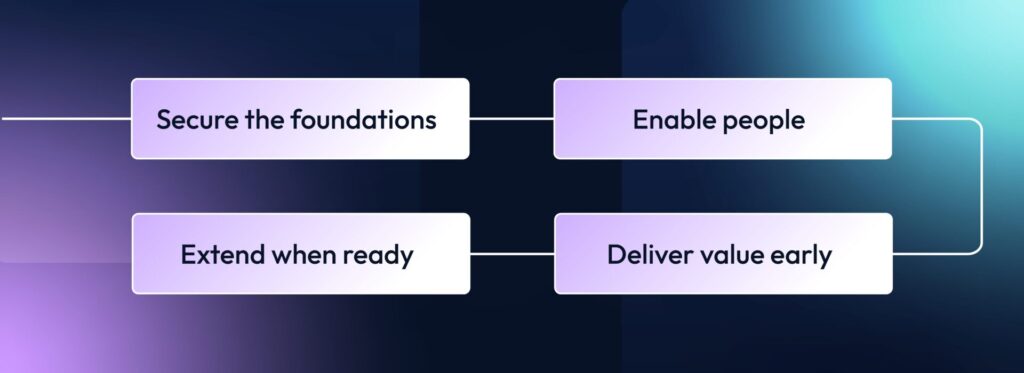
Across industries, organisations are learning that safely adopting AI at scale isn’t a single leap. It’s a journey made up of real, practical stages:
- Secure the environment
- Enable and empower people
- Deliver practical value early
- Then push into advanced possibilities when you’re ready
Whether you’re Manchester City Council, Calisen, Burgess Salmon, Facial Palsy UK, or Aventum, the path is different, but the pattern is the same.
AI isn’t about replacing people. It’s about freeing them.
It’s about building confident, modern, adaptable organisations that can step towards the frontier with clarity, not chaos.
Ready to accelerate your own Frontier Firm journey?
Our transformation proves that becoming a Frontier Firm isn’t theoretical – it’s practical, achievable, and already happening inside organisations that commit to the right foundations. If you’re ready to turn AI ambition into real world impact, you don’t have to take the journey alone.
Our AI Readiness Assessment is a structured engagement that maps your current landscape and provides a roadmap for successful Copilot and Agentic AI implementation.
It will help you understand how to lay technology foundations across Cloud, Security, Data, and Digital, as well as putting Enablement plans in place to ensure widespread adoption.
No matter your requirements across Copilot M365, Copilot Studio, or Foundry, our expertise ensures you gain a clear understanding of the governance needed at every stage – while implementing enablement plans that unlock your organisation’s agentic future with Microsoft.
Sign up for an AI Readiness Assessment today and chart your course to the Frontier.