For most people these days, AI no longer feels like a novelty. Tools like Copilot, ChatGPT, and built-in AI assistants in search engines and word processors have slipped seamlessly into our daily routines. We use them to draft emails, brainstorm ideas, summarise information, or plan everything from meal plans to meetings.
AI has transformed from a curiosity into a default tool people reach for without a second thought. As we’ve grown used to these familiar, prompt-based forms of AI (often referred to as generative AI), the emergence of newer AI models, like Agentic AI, can feel surprisingly disorienting.
This blog explains the differences between generative AI and agentic AI, helping to untangle terminology and demystify the differences in best practice and use cases.
Agency vs. Assist
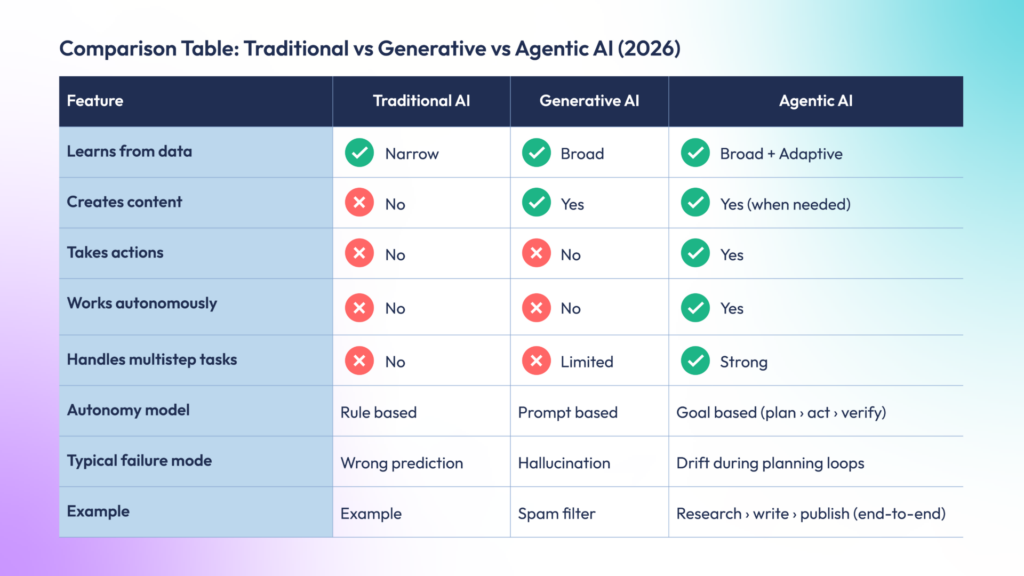
The defining difference between agentic AI and more traditional or generative AI comes down to how much initiative the AI is designed to take.
Traditional and generative AI systems wait for direction, operating within clearly defined prompts, inputs, and outputs. They generate content or insights, but they don’t act independently.
Agentic AI, by contrast, is built to take a more active role. Rather than stopping at recommendations or responses, agentic systems can plan, decide, and take action in pursuit of a goal.
Put simply:
- Generative AI produces outputs
- Agentic AI works toward outcomes
Let’s look at how this plays out in common workplace scenarios.
With traditional or generative AI, email support is largely assistive. For example, you might ask an AI tool to draft a response, summarise a long email chain, or rewrite a message to sound more professional. In all cases, you remain in full control, deciding when and how the AI is used, and whether anything gets sent.
Agentic AI takes matters further. Instead of waiting to be prompted, an agentic system can monitor an inbox for specific triggers, like unanswered queries, approaching deadlines, or signs of escalation. Based on this, it can draft replies, prioritise messages, send follow‑ups after a set period, and even route issues to the correct team if it detects urgency or risk.
Agentic AI doesn’t just help write emails; it manages the workflow around them.
Meetings
Traditional and generative AI are already useful in meetings for support tasks like transcribing conversations, generating summaries, extracting action items, and highlighting key decisions. These outputs are valuable, but they still rely on someone reviewing them and taking the next step.
Agentic AI treats meetings as part of a broader objective. After a meeting ends, an agentic system might update the CRM, schedule follow‑up meetings, draft personalised proposals, notify stakeholders, and track whether actions are completed. All of this can happen with little to no manual intervention.
Reporting and Analysis
In reporting and analysis, traditional and generative AI excel at answering specific questions, such as analysing last quarter’s performance or identifying trends in customer behaviour. The AI provides insights, but interpretation and decision making remain human‑led.
Agentic AI can be given a higher level goal, like “improve customer retention.” From there, it can analyse data, test hypotheses, identify risks, and recommend actions. In more advanced setups, it can even initiate those actions, such as triggering customer outreach, launching campaigns, or alerting human teams when thresholds are crossed.
Which AI Should You Use?
For most organisations, the choice isn’t binary. Traditional and generative AI are ideal for well defined, repeatable tasks where human judgement remains central. Agentic AI is better suited to complex workflows that span systems and teams, especially for organisations looking to operate more quickly and at scale.
Small and medium sized organisations often start with generative AI to build confidence and secure quick wins, then gradually introduce agentic capabilities as their processes mature. Meanwhile, enterprises are increasingly exploring agentic AI to automate end-to‑end workflows and reduce friction across complex environments.
Learn how to adopt agentic AI with Co-Managed Copilot and start building your Frontier Firm today.