
Agentic AI is a term you’ve probably started to notice popping up, and trust us, you’ll be seeing a lot more of it in 2026. For organisations looking to stay ahead of the AI curve, understanding agentic AI isn’t just a nice-to-have; it’s an essential for streamlining workflows and boosting efficiency.
While traditional AI has helped organised analyse and predict, and generative AI has helped people create content faster, both models remain largely prompt-driven. Humans still need to connect the steps, push work forward, and make the decisions that turn outputs into outcomes. Neither fundamentally changes how work moves through the business, and this is where momentum tends to slow down.
Agentic AI represents a major shift as it drives workflows. Traditional AI predicts. Generative AI creates. But Agentic AI acts.
In this guide to Agentic AI, we’ll tackle the big questions organisations are asking, including:
- What is agentic AI?
- What is an AI agent?
- Types of AI agents
- Which industries will benefit most?
- What are key use cases for agentic AI?
- How can organisations adopt Agentic AI safely and responsibly?

What is agentic AI and how does it work?
Agentic AI does pretty much what it says – bringing a sense of agency and autonomy to AI. Instead of the traditional, constrained, and purely reactive AI systems, it introduces proactiveness and adaptability. Think of it as AI that doesn’t wait for instructions; it acts, pursues goals, and does so with minimal human supervision. In short: traditional AI informs, but agentic AI acts.
Agentic AI Examples
If a traditional AI customer success tool flags that a client may be at risk of leaving, it will give you the insight and data to evidence this. However, agentic AI will create and implement action, planning and executing retention steps like sending personalised emails, booking calls, and monitoring responses. This allows your organisation to do more with less, keeping within boundaries that you define.
What is an AI agent?
Agentic AI operates using ‘AI agents’, which are systems designed to act autonomously toward a goal. They can be imagined as helpful virtual assistants that perform tasks or manage workflows on your behalf. They can:
- Understand a goal
- Break it into steps
- Take actions using connected tools (email, calendar, CRM, ticketing, knowledge bases)
- Check results
- Adapt if the situation changes
At its simplest, an AI agent just needs a goal, such as ‘increase customer engagement’ or ‘book the best flight to Thailand in August’, and it will plan, act and adapt based on changes or the data it receives.
It’s currently standard practice to have one AI agent per goal or have multiple AI agents working together on different parts of a process. How many AI agents you have depends on resources and data flow.
How do AI Agents work?
AI agents work through a simple loop: they observe what’s happening, decide the next best action, execute it using connected tools, and then check the outcome to adjust their next move. This continuous perceive-plan-act cycle is what lets them handle tasks independently and adapt as conditions change.

Types of AI Agents
As organisations advance toward more autonomous workflows, it helps to understand the main types of AI agents and how they differ:
- Simple reflex agents act purely on real-time insights using predefined rules, making them suitable for stable, predictable tasks.
- Model-based reflex agents use an internal model of the environment, allowing them to apply context and make more informed decisions.
- Goal-based agents evaluate different actions and choose the one that best moves them toward a defined objective.
- Learning agents improve performance over time by analysing outcomes and adjusting their behaviour without human intervention.
- Simple-agent and multi-agent. Many organisations begin with a single agent handling one workflow end-to-end. More mature setups adopt multi-agent systems, where specialised agents collaborate across research, execution, validation and reporting to deliver scalable, enterprise-grade automation.
Which Industries Will Benefit Most?
Almost every industry is exploring agentic AI, but the greatest impact appears in sectors with repeatable workflows, heavy admin or time-critical operations. This is where automation can remove friction quickly and effectively.
What are key use cases for agentic AI?
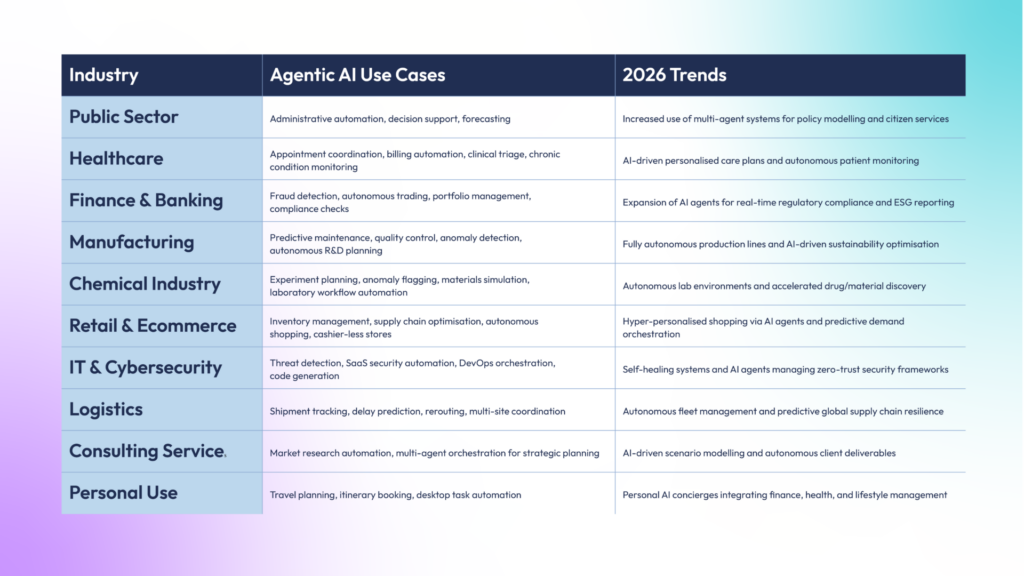
We’ve already discussed a few, but there are many use cases for agentic AI, and these vary depending on your organisation’s goals and industry type.
Here are some of the most common use cases for agentic AI in the UK, along with some emerging trends:
How Do We Start Adopting Agentic AI Safely to Become a Frontier Firm?
Safe adoption starts with strong foundations. Most Frontier-minded organisations follow a structured path to move from AI readiness to AI realisation to agentic capability.
- Start with Copilot adoption
Understand how people actually use AI and where productivity gains appear. This builds confidence and reveals real workflows that could later benefit from automation.
- Strengthen identity, permissions, and data governance
AI agents can take actions, so access boundaries and data guardrails must be correct. This includes identity hygiene, least-privileged access, data classification, and secure information architecture.
The main security risks come from how agentic AI accesses, processes, and acts on data. Because these systems can take autonomous actions, organisations need to maintain visibility into what information the AI can reach and how it’s being used. Thorough risk assessments and robust access controls additionally help ensure that AI agents don’t expose sensitive data or behave in unexpected ways.
- Choose one or two high-confidence workflows
Start with predictable processes, such as renewal preparation, ticket triage, onboarding, or compliance reporting.
- Build guardrails and approvals
Human oversight remains in control. Agents should only act within predefined rules, policy boundaries, and approval flows.
- Ethics
Agentic AI can be ethical, but it depends on the safeguards an organisation puts in place. Strong governance and clear accountability (with well-designed guardrails) help ensure that AI systems act in line with organisational values and legal requirements. Without these measures, there’s a higher risk of biased outcomes or unintended decisions, making responsible oversight essential.